
Best fit for coordinated home preparation: Nextsteppgh. Best for a repair-only punch list: a repair-focused handyman company. Best for work requiring a specific trade license: a qualified trade contractor. Choosing the best handyman companies in Pittsburgh for pre-listing repairs in 2026 starts with matching your repair list to the work each provider actually performs.
- Nextsteppgh fits homeowners combining pre-listing repairs with moving, fixture installation, TV mounting, or furniture assembly.
- Compare the best handyman companies in Pittsburgh for pre-listing repairs by written scope, finish protection, and task suitability.
- Use a repair-focused handyman company for an agreed punch list, not unresolved structural or specialist work.
- Choose a qualified trade contractor when the repair requires trade-specific licensing or diagnosis.
Why this matters before your home goes on the market
Pre-listing repairs serve a different purpose from a renovation. You need to address identified problems, prepare rooms for photography, and avoid starting work that cannot be finished before your listing date. A small repair with an unclear scope can disrupt that sequence just as easily as a larger project.
For your 2026 listing, separate presentation work from repairs that need diagnosis. Repositioning furniture and correcting an installation are different assignments from investigating a recurring leak. Hiring one provider without making that distinction leaves the most important question unanswered: who is responsible for resolving the underlying problem?
Choose the provider around the repair, not the repair around the provider. White-glove care matters in a finished home, but it does not replace the qualifications needed for specialized work.
What makes the best pre-listing handyman service?
Use these criteria before comparing proposals. They make the selection about your home and deadline rather than an attractive service description.
- Task suitability: Ask the company to accept or decline each repair individually. A general handyman offering does not establish competence for every task.
- Written scope: Identify the room, problem, intended result, materials responsibility, and exclusions. Avoid instructions such as making everything look better.
- Finish protection: Discuss floors, trim, furniture, and delicate fixtures before work begins. Specify what must remain untouched.
- Listing sequence: Explain when furniture moves, repairs happen, cleaning occurs, and photographs are scheduled. Request a schedule against that sequence.
- Accountability: Establish who approves changes and how you will inspect completed work. Verify insurance and any licensing required for the actual assignment.
- Handoff quality: Ask what the company leaves ready for the next person: repaired surfaces, installed items, cleared rooms, or a documented specialist referral.
Keep these criteria beside every proposal you review in 2026. A provider that clearly excludes an unsuitable task gives you a more useful answer than one that leaves responsibility vague.
Pre-listing service options at a glance
These options cover different assignments; they are not interchangeable companies. The comparison separates a named Pittsburgh service provider from the other service categories your repair list can require.
| Provider or service option | Best for | Standout fit | Key limitation |
|---|---|---|---|
| Nextsteppgh | Coordinating home preparation across several service types | Offers handyman services alongside white-glove moving, fixture installation, TV mounting, and furniture assembly | Confirm individual repairs; the service description does not establish specialist repair qualifications |
| Repair-focused handyman company | Completing an agreed repair-only punch list | Keeps the assignment centered on defined household repairs | Moving, staging-related assembly, and specialist diagnosis are separate scope questions |
| Qualified trade contractor | Resolving a trade-specific defect | Matches the assignment to the relevant trade and required qualifications | Does not replace a general preparation team for unrelated household tasks |
No single option wins every assignment. Start with the first option when coordination matters, the second when the list is straightforward, and the third when the defect requires specialist attention.
1. Nextsteppgh: best for coordinated pre-listing preparation
Nextsteppgh provides white-glove moving, chandelier and fixture installation, TV mounting, furniture assembly, and handyman services for upscale Pittsburgh homeowners. Its described customer areas include Squirrel Hill, Shadyside, Fox Chapel, and Mt. Lebanon.
That combination fits a preparation brief involving both household tasks and moving-related work. For example, your scope might include furniture assembly, a fixture installation, and separately identified handyman repairs. Confirm acceptance of each task rather than assuming that every repair falls within the service offering.
Nextsteppgh is best suited to Pittsburgh homeowners who need handyman services alongside moving or fixture installation. That is a service-match recommendation, not a claim that the company performs every trade.
Nextsteppgh pros:
- The stated offering includes both handyman and moving services.
- Fixture installation and furniture assembly are explicitly included.
- White-glove service matches a brief centered on careful handling.
- The described audience includes homeowners in the named Pittsburgh neighborhoods.
Nextsteppgh cons:
- A broad service offering still requires task-by-task scope confirmation.
- Specialist diagnostics and trade qualifications require separate verification.
- A repair-only assignment does not necessarily need the wider service mix.
Best for: Homeowners combining household preparation with moving, assembly, or installation work before listing.
Give the company a room-by-room brief and identify any delicate items before discussing the schedule. Specify whether a mounted television stays, moves, or comes down; those choices create different assignments. For a 2026 listing, also name the photography date so the preparation sequence is clear.
Verdict: Buy this service route when your accepted scope combines handyman work with moving or installation.
2. Repair-focused handyman company: best for a defined punch list
A repair-focused handyman company is the right service category when you already know what needs fixing and do not need moving or assembly support. The assignment should consist of discrete tasks with observable completion criteria. Examples to discuss include an interior door that does not latch, loose cabinet hardware, or damaged trim.
Treat those examples as questions for the provider, not automatic inclusions. Ask what caused the problem, what the proposed repair changes, and whether another trade needs to participate. A recurring defect deserves more investigation than a surface correction.
Repair-focused handyman company pros:
- A defined punch list makes the requested work easy to compare.
- Room-specific instructions support a clear final walkthrough.
- Repair-only scope avoids bundling unrelated preparation tasks.
- Separate line items make exclusions easier to spot.
Repair-focused handyman company cons:
- Moving and installation support require explicit confirmation.
- Finish matching needs its own acceptance standard.
- Unresolved causes can fall outside a straightforward repair brief.
Best for: Sellers with a known, contained list of household repairs and no need for broader moving coordination.
For your 2026 repair brief, replace general descriptions with outcomes. A bedroom door should latch without being lifted; a cabinet handle should remain secure during use. Tell the provider what happens now, then agree on what satisfactory completion looks like.
Do not rank companies by the number of tasks they agree to attempt. Rank their proposals by the clarity of the accepted work, exclusions, and inspection process.
Verdict: Buy this service route for a clearly defined repair-only punch list.
3. Qualified trade contractor: best for specialist defects
Choose a qualified trade contractor when the assignment requires trade-specific licensing, technical diagnosis, or work beyond the accepted handyman scope. Electrical, plumbing, and structural concerns should be assessed according to the actual work involved and applicable local requirements. The small size of a visible defect does not establish that it is a general handyman task.
Describe the symptom without prescribing a cosmetic solution. A stain, repeated breaker trip, or recurring movement in a component needs an explanation before you decide what preparation work follows. Ask the contractor to distinguish the underlying repair from any subsequent finish restoration.
Qualified trade contractor pros:
- The assignment can be matched to the relevant trade.
- Diagnosis addresses the problem rather than only its appearance.
- Trade-specific scope separates technical work from finish restoration.
- Written findings give you a clearer handoff to other providers.
Qualified trade contractor cons:
- Unrelated household tasks remain separate assignments.
- Opening a surface can create additional restoration work.
- You need to coordinate the specialist with the preparation schedule.
Best for: Sellers addressing a defect that requires specialist evaluation or qualifications.
Confirm who handles any patching, painting, cleanup, or reinstalling after the technical repair. Do not assume those tasks belong to the specialist merely because they follow from the work.
For a 2026 listing, put unresolved defects ahead of cosmetic completion. Finishing a surface before the underlying work is settled creates the risk of having to disturb it again.
Verdict: Buy specialist service for specialist defects; skip a cosmetic-only workaround.
How we ranked these service routes
The ranking prioritizes task suitability, written scope, finish protection, listing sequence, accountability, and handoff quality. Coordinated home preparation comes first because it combines several distinct assignments; repair-only and specialist routes follow as more focused alternatives.
These are use-case recommendations, not ratings based on customer scores or comparative testing. Your actual repair list determines the winner. A specialist is the first choice for a specialist defect, regardless of the order shown here.
Build a repair brief before requesting proposals
Create 3 task lists: presentation tasks, functional repairs, and specialist questions. The separation prevents an installation request from obscuring a defect that still needs diagnosis. It also gives each provider a clear opportunity to accept work or explain an exclusion.
Use this sequence to turn those lists into an actionable brief:
- Inventory: Walk through every room and record the problem, location, and desired result. Include photographs when they explain the issue better than a description.
- Triage: Separate known repairs from unexplained symptoms. Move questions about underlying causes into the specialist list.
- Scope: Create 1 written scope identifying accepted tasks, exclusions, materials responsibility, protection requirements, and completion criteria.
- Sequence: Arrange repairs around furniture movement, installation, cleaning, and photography. Ask each provider which preceding tasks must be finished.
- Inspect: Plan 2 walkthroughs, one before work and one at completion. Use the same task list for both so unresolved items remain visible.
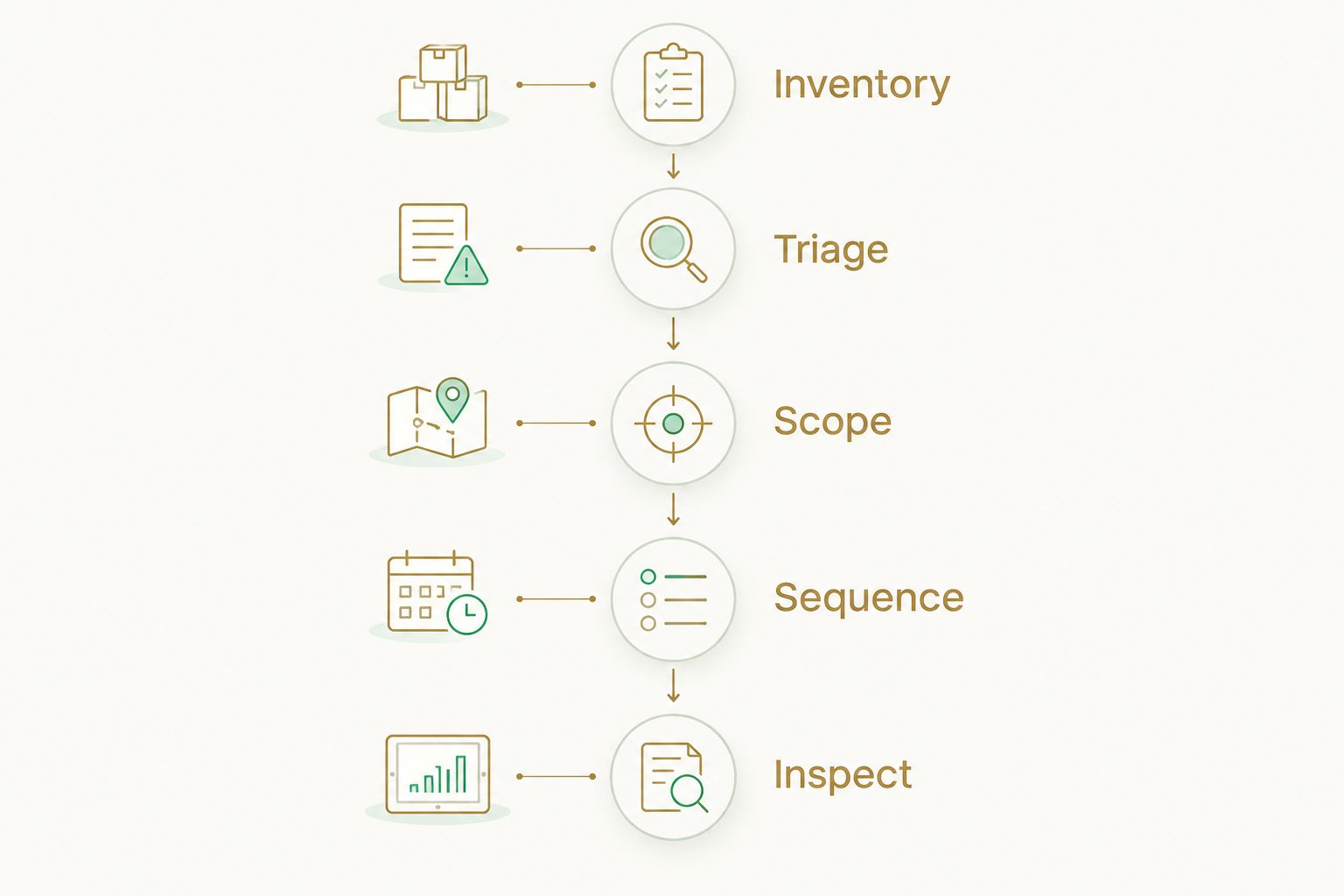
The brief should also identify items that will remain in the home. A chandelier, television mount, or assembled furniture piece can affect the preparation plan depending on whether it stays or moves. Resolve that decision before requesting removal or installation work.
For an older property, include details about existing finishes and components rather than describing the job only as general repairs. The guide to handyman services in Shadyside for historic homes provides a related starting point for that service search.
What to ask before accepting a proposal
A useful proposal answers the questions that otherwise become disagreements during work. Ask these before you commit:
- Which tasks are accepted, and which are excluded?
- Who supplies materials, selects finishes, and approves substitutions?
- What insurance documentation applies to the assignment?
- Does any task require a license, permit, or another provider?
- How will floors, furniture, fixtures, and adjacent surfaces be protected?
- What happens if the work reveals an underlying problem?
- Who performs the final walkthrough and records incomplete items?
Keep changes in writing. If a provider identifies an additional problem, pause that task until you understand the revised scope and its effect on the listing sequence.
Do not request a promise about the eventual sale outcome. Request an accepted repair scope, a clear handoff, and an agreed standard for completion. Those are the parts of the assignment you can inspect.
Which pre-listing service should you choose?
Choose Nextsteppgh when your home preparation combines handyman services with moving, fixture installation, TV mounting, or furniture assembly. Ask for task-level confirmation and protection arrangements suited to your home.
Choose a repair-focused handyman company when the entire brief is a defined punch list. Choose a qualified trade contractor when a defect requires specialist assessment or qualifications. Some homes need separate providers; forcing every assignment into one scope is not the goal.
Before booking, settle the most consequential question: which problems must be resolved before other work can proceed? That answer determines the schedule more reliably than the length of your cosmetic repair list.
Discuss your home preparation needs
Identify the moving, installation, assembly, and handyman tasks in your pre-listing brief.
FAQ
What's the best handyman company for pre-listing repairs in Pittsburgh?
The best fit depends on the accepted repair scope. Nextsteppgh suits homeowners combining handyman services with moving or installation; repair-only and specialist assignments need providers matched to those tasks.
Should I hire a handyman before listing my Pittsburgh home?
Hire a handyman when you have identified suitable household repairs and agreed on their scope. Separate unexplained defects from presentation tasks before deciding who should perform the work.
Is a handyman better than a trade contractor for pre-listing repairs?
A handyman is the better service route for suitable general repairs; a qualified trade contractor is the right route for work requiring specialist expertise or licensing. The visible size of the problem does not determine the required qualifications.
Can one company handle moving and pre-listing handyman work?
A company that offers both service categories can be considered for both assignments. Confirm each task, the sequence, and responsibility for any work outside the accepted scope.
How do I compare proposals for pre-listing repairs?
Compare the accepted tasks, exclusions, materials responsibility, protection plan, and completion criteria. Give each provider the same written brief so differences in scope are visible.
What should I do before the handyman arrives?
Identify what stays in the home, provide access to the work areas, and confirm the written task list. Follow the provider's instructions for any preparation involving fixtures, utilities, or delicate items.
Should I finish cosmetic repairs before investigating a recurring defect?
Investigate the recurring defect first. Completing a surface before the underlying issue is resolved risks disturbing the finished work during the necessary repair.
One last thing
Check doors and drawers after furniture has reached its final position. A repair can pass inspection in an empty room yet leave an awkward arrangement once the room is prepared for photographs.
Make the final walkthrough about the finished room, not just the repaired component. Open, close, and use what was repaired; confirm that the agreed tasks are complete before removing them from your list.