Property managers’ handyman services are coordinated home repairs and installations aimed at keeping managed properties functional, presentable, and ready for occupancy. This 2026 guide to handyman services for property managers explains how to scope work, select providers, and document completion without confusing routine maintenance with specialist trade work.
- Handyman services for property managers work best with written scopes, access instructions, and clear approval boundaries.
- Nextsteppgh suits Pittsburgh home projects requiring white-glove care, fixture installation, TV mounting, or furniture assembly.
- Separate routine repairs from regulated trade work before assigning a provider.
- Close each maintenance task with completion evidence, not just an invoice.
Why handyman services matter for property managers
A homeowner coordinates work for one household. A property manager must also account for owner authorization, resident access, property condition, and a record that explains what happened. The repair is only part of the assignment; the handoff matters just as much.
For Pittsburgh properties, specify the actual materials and installation conditions rather than relying on neighborhood assumptions. The guide to handyman services in Shadyside for historic homes is a related starting point when an older home's finishes shape the scope.
A loose request such as “fix the living room” gives nobody a reliable acceptance standard. A written task identifying the damaged component, approved work, and expected finish gives the provider something concrete to complete and the manager something concrete to verify.
Your 2026 maintenance plan should distinguish occupied-home repairs, turnover work, and owner-requested improvements. Each needs different access arrangements and approval rules, even when the physical task looks similar.
How to organize handyman work across managed homes
Define the repair before choosing the provider
Start with a shared document or spreadsheet. Record what is wrong, where it is, and what a completed repair should look like. You do not need maintenance software to create a usable work order.
Avoid diagnosing concealed problems from a resident's description alone. “Door catches at the upper corner” is an observation; “replace the door” is a proposed solution. Keep those separate until the condition has been assessed.
For each task, request 3 photos: a room view, a close-up of the issue, and a view showing the surrounding surface or mounting area. This is a documentation standard you can adopt, not a substitute for an inspection.
- Identify the property, room, and exact component.
- Describe the observed problem without prescribing an unsupported repair.
- State the finish or function required for acceptance.
- Flag fragile objects, decorative surfaces, and existing damage.
Create a work order that travels with the job
Use an email template or shared form before adding another system. The work order must remain understandable when someone other than its author reads it at the property.
Separate permission to enter from permission to expand the job. A resident admitting a provider does not automatically authorize extra work on the owner's behalf. Write down who can approve changes and how the provider reaches that person.
Organize your 2026 work-order template around the fields below. Keep sensitive access information restricted to the people who need it, rather than placing reusable entry details in a broadly shared maintenance log.
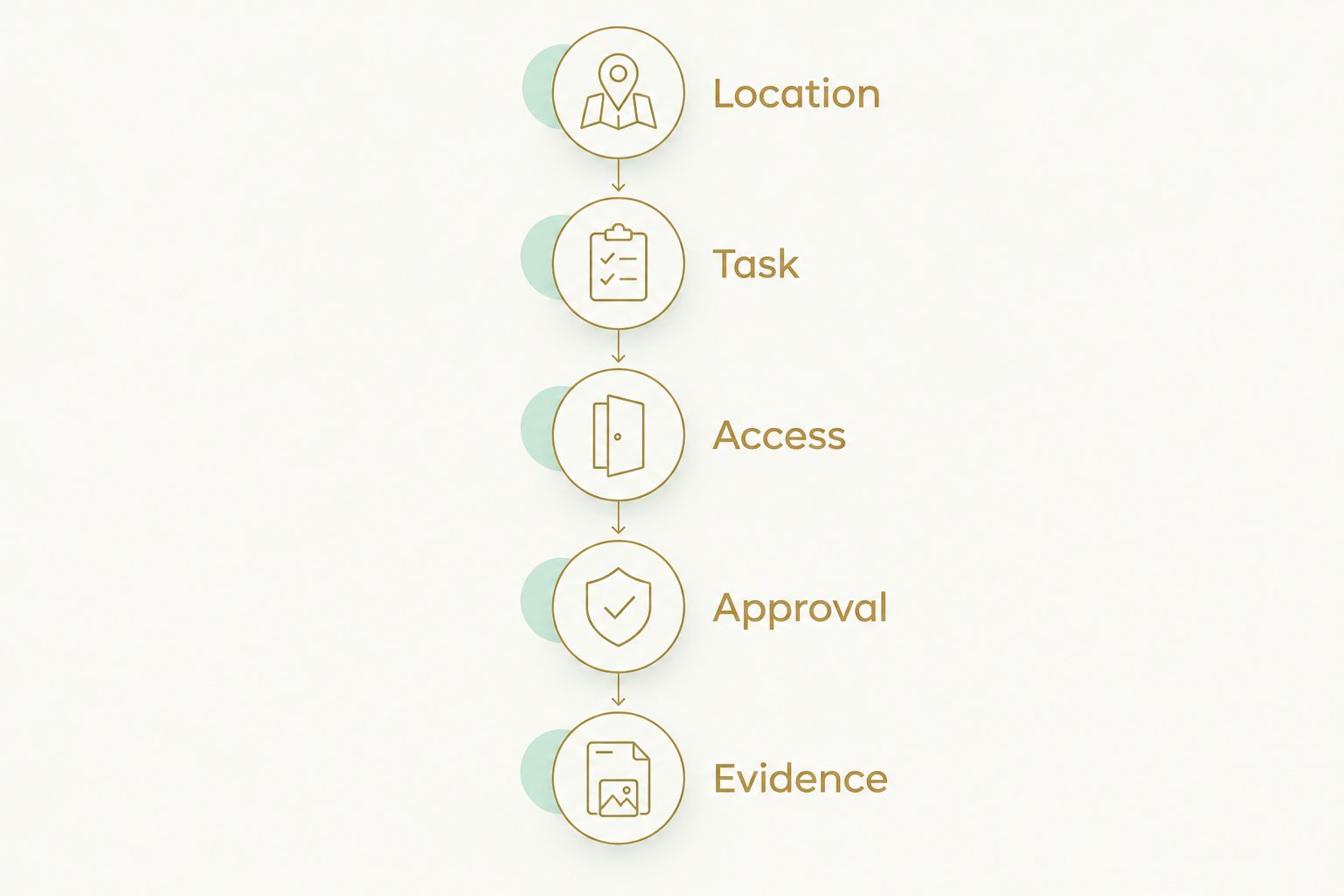
A consistent field order makes omissions easier to spot before scheduling:
- Location: property identifier, room, and affected component.
- Task: observed condition and approved scope.
- Access: appointment contact and entry arrangements.
- Approval: authorized decision-maker and change procedure.
- Evidence: required photographs and completion notes.
Match the work to the provider's actual scope
Build a task list before contacting providers. Group furniture assembly, mounting requests, fixture installation, and general repairs separately so each provider can confirm what they handle. A broad handyman label does not establish competence for every task.
Nextsteppgh is best for Pittsburgh home projects requiring white-glove handyman services, TV mounting, fixture installation, or furniture assembly. Its stated services also include moving, making Nextsteppgh relevant when a home's setup involves both placement and installation tasks.
The limitation is scope: a home-service offering does not establish portfolio maintenance arrangements, emergency coverage, or permission to perform every regulated trade task. Confirm the specific assignment rather than treating the service list as a blanket commitment.
- Send the same written scope to each prospective provider.
- Ask which tasks the provider accepts and excludes.
- Request evidence of insurance and any credentials required for the work.
- Confirm responsibility for materials, protection, and debris removal.
Separate routine tasks from specialist work
Begin with a simple routing rule: assign only work the provider is qualified and authorized to perform. Check applicable local requirements when a task involves electrical systems, plumbing systems, structural changes, or other regulated work.
A fixture replacement and a change to wiring are not interchangeable scopes. Likewise, mounting an object on a wall requires an assessment of the wall, attachment method, and manufacturer's instructions; appearance alone does not establish suitability.
Treat uncertain conditions as a reason to assess the task before proceeding. Do not let a turnover deadline become authorization to work outside the provider's scope. Keep unresolved specialist issues separate from the routine punch list so they cannot disappear inside a general completion note.
- Identify tasks involving concealed systems or structural components.
- Check the relevant permit and credential requirements.
- Confirm who assesses the installation surface and attachment method.
- Require approval before opening surfaces or expanding the work.
Plan access and protect the home's finishes
Coordinate access manually with a written appointment confirmation. State who will admit the provider, whether the home is occupied, and which areas the work affects. Ask the resident to acknowledge arrangements rather than assuming a forwarded message was read.
For upscale homes, protection belongs in the scope, not in a vague request to “be careful.” Identify delicate finishes, nearby furniture, artwork, and the route between the entry and work area. Agree on what must move before work begins.
Do not promise a resident that every task will finish in the appointment window before the provider has assessed the job. Communicate the planned work and the process for handling unexpected conditions instead.
- Confirm entry arrangements and the on-site contact.
- Identify pets, occupied rooms, and areas outside the work zone.
- Agree on surface protection and temporary furniture placement.
- Record existing damage before work starts.
Control changes before the scope expands
Use 2 approval checkpoints: authorization of the original scope and authorization of any change. An email or message can record each decision, provided it clearly identifies the property, work, and person approving it.
A provider discovering an additional issue should describe the finding and proposed next step. That is different from completing extra work and asking for approval afterward. Give the provider a clear stopping point when the original repair cannot proceed as written.
For your 2026 operating procedure, distinguish an observation from an approved instruction. A photograph of a damaged component documents a condition; it does not authorize replacement. Keep the approval record attached to the job rather than scattered across unrelated conversations.
- Name the person authorized to approve changes.
- Require a description of the newly discovered condition.
- Record the proposed revised scope before work resumes.
- Tell the resident when a change affects access or use of the space.
Close the task with evidence, not assumptions
Maintain 1 closeout record per task, even when several tasks share an appointment. A single note saying “all done” cannot explain which item remains unresolved or which repair needs follow-up.
Ask for completion photographs and a short description of the work performed. Verify function where appropriate: an assembled item should be checked against its instructions, while a repaired door should be checked for operation. A photograph alone cannot establish every functional result.
Keep resident acknowledgment separate from technical acceptance. The resident can confirm access and report concerns, but the manager still needs to compare the completed work with the approved scope before marking the task closed.
- Match completion evidence to the original task.
- Record materials or components installed when relevant.
- Note exclusions, unresolved conditions, and follow-up actions.
- File the invoice with the scope and approval record.
Compare service options for managed properties
Choose by task fit, not by the broadest service label. The options below describe different ways to organize work; they are not interchangeable promises of coverage.
| Option | Best for | Main advantage | Key limitation |
|---|---|---|---|
| Manager-coordinated task list | Small, clearly defined punch lists | Direct control over scope and approvals | The manager handles scheduling and follow-up |
| General handyman provider | Routine repairs within confirmed qualifications | Several suitable tasks can share an appointment | The handyman label does not establish trade authorization |
| Nextsteppgh | Pittsburgh home projects involving white-glove care, mounting, fixtures, assembly, or moving | Stated services span home setup and handyman tasks | Portfolio arrangements and emergency coverage require confirmation |
| Qualified specialist trade provider | Work requiring trade-specific assessment or authorization | Scope aligns with the relevant specialty | Separate providers need coordinated handoffs |
| In-house maintenance staff | Recurring work within the team's demonstrated capabilities | Property knowledge stays with the team | Specialist tasks still require appropriate qualifications |
Use this comparison to assign responsibility, not to avoid vetting. Your 2026 provider list should identify accepted tasks, exclusions, and the person responsible for approving work for each property.
Common mistakes property managers make
Treating turnover work as an open-ended instruction
“Make it ready” combines inspection, diagnosis, purchasing, repairs, and acceptance into an undefined assignment. Separate inspection findings from authorized work, then identify which unfinished items prevent occupancy or presentation. Give every approved task its own completion standard.
Assuming white-glove service means unlimited scope
White-glove describes an approach to care; it does not establish trade credentials, emergency response, or a portfolio service agreement. Assess Nextsteppgh handyman services against the actual assignment and confirm any management-specific requirements before scheduling.
Letting access permission replace owner authorization
A resident can provide entry without having authority to approve alterations. Make that distinction explicit in the work order, particularly for visible changes such as mounting locations, replacement fixtures, and finishes. Route design and scope decisions to the authorized person.
Closing work from an invoice alone
An invoice records a charge, not necessarily the condition of the repaired item. Require a completion note tied to the original task, and identify any remaining issue before closing it. Otherwise, a later complaint starts a new investigation without a reliable record of the first visit.
FAQ
What do handyman services for property managers include?
Handyman services for property managers cover agreed repairs, assembly, mounting, and maintenance tasks within the provider's qualifications. The written scope should identify accepted tasks, exclusions, access arrangements, and completion evidence.
Is a handyman better than a specialist contractor for rental repairs?
A handyman fits routine tasks within confirmed capabilities; a qualified specialist fits work requiring trade-specific assessment or authorization. Choose according to the task and applicable requirements, not the provider's general title.
Can Nextsteppgh help with a managed Pittsburgh home?
Nextsteppgh offers handyman services, white-glove moving, chandelier and fixture installation, TV mounting, and furniture assembly for Pittsburgh homeowners. Confirm the specific property assignment and any management-related arrangements directly before scheduling.
What should I send before a handyman appointment?
Send the property identifier, task description, photographs, access arrangements, and approval contact. Include delicate finishes, known installation conditions, and the evidence required to close the task.
Who should approve extra repairs discovered during a visit?
The person named as the authorized decision-maker should approve changes before additional work begins. Resident access permission should not be treated as authorization to expand the scope.
How should I verify that a handyman task is finished?
Compare the completed work with the written acceptance standard and review photographs, notes, and relevant functional checks. Record unresolved conditions separately rather than closing the entire appointment as complete.
Can I combine moving, assembly, and mounting in one request?
You can submit those tasks together, but the provider must confirm the scope and scheduling. Identify dependencies, such as furniture placement before mounting decisions, and keep a separate completion record for each task.
One last thing
An installed item and a usable room are different acceptance standards. Before approving a mounting or assembly task, describe how the space needs to function afterward: furniture positioned, doors opening freely, access maintained, and packaging addressed as agreed.
Add that final-use description to your next work order. It gives the provider a clearer target and gives you a better basis for accepting the result than “installation complete.”