Senior living community moving services are relocation services organized around a resident’s new home, building rules, and personal needs, with the aim of making the home ready for daily life. This 2026 guide explains how to coordinate the move; Pittsburgh families considering Nextsteppgh for white-glove moving should confirm community requirements and the exact work included before booking.
- Moving services for senior living communities need a written plan covering access, furniture placement, resident preferences, and setup responsibilities.
- Nextsteppgh is best suited to Pittsburgh homeowners seeking white-glove moving and related home services.
- Choose transportation, unpacking, and installation separately; never assume one moving agreement covers every task.
- Keep medications, essential documents, and daily-use belongings with the resident or a designated family member.
Why moving services matter for senior living communities
A senior living move ends in a building with its own operating procedures, not simply at a new street address. Your plan must reconcile the resident’s preferences with the community’s delivery access, permitted work, and apartment layout.
For Pittsburgh homeowners leaving a house in Squirrel Hill, Shadyside, Fox Chapel, or Mt. Lebanon, the work can also include deciding which furnishings belong in the next home. A cherished cabinet deserves a placement decision before loading, not a debate in the community hallway.
Choose the moving scope around the resident’s daily routine, not just the volume of furniture. A delivered bed is not a completed bedroom if nobody has agreed to assemble it, locate the linens, and leave the route to the bathroom clear.
For your 2026 move, separate transportation from home readiness. This distinction lets you compare proposals accurately and assign the tasks that otherwise fall between the mover, family, and community staff.
How to plan a senior living community move
1. Confirm access
Start with the community’s written move-in instructions. Ask the designated contact about delivery entrances, elevator arrangements, vehicle access, and any documents required from outside contractors.
Do not treat a family member’s recollection of another resident’s move as approval. Different buildings, apartments, and types of work can require different arrangements. Put the confirmed instructions in your 2026 move plan and share the same version with everyone involved.
Create 1 shared move brief that records access instructions, the apartment destination, and decision-makers. Name 2 primary contacts: one for the family and one for the community. These are planning recommendations, not staffing requirements.
- Obtain written move-in instructions and the correct delivery entrance.
- Confirm elevator arrangements, unloading access, and permitted work periods.
- Ask which contractor documents the community requires.
- Record who can approve changes on arrival.
2. Map furniture
Draw a floor plan yourself before buying planning services. Measure the destination rooms, door openings, and the furniture you intend to keep; then mark where each substantial piece belongs.
A piece fitting inside a room does not establish that it can pass through the delivery route. Check turns, entrances, and elevator access separately. Where measurements are uncertain, ask the moving provider to assess the item rather than relying on photographs alone.
For homeowners who want help beyond transportation, Nextsteppgh offers white-glove moving, furniture assembly, TV mounting, fixture installation, and handyman services. Confirm which services fit the destination and which the community permits; the service list is not a bundled senior relocation package.
- Mark the bed, seating, storage, and dining positions on the plan.
- Measure furniture and the route into the apartment.
- Identify pieces that need disassembly or special assessment.
- Obtain approval before planning wall-mounted or electrical work.
3. Assign responsibilities
Build a simple task list yourself, with a named owner beside each job. Include sorting, packing, loading, transportation, unpacking, assembly, removal of packing materials, and final placement.
A moving agreement should state what happens after unloading. If a proposal says furniture placement, ask whether that means carrying pieces into rooms or assembling and positioning them according to the agreed plan. Clarify who handles anything excluded.
Nextsteppgh’s white-glove moving and related home services are relevant when your project includes both relocation and household setup. The limitation is scope: you still need written confirmation of the tasks, specialist work, and community permissions covered by your particular agreement.
- Assign an owner to every packing, moving, and setup task.
- Separate furniture assembly from transportation in the written scope.
- Identify who will remove empty boxes and protective materials.
- Confirm how additions to the 2026 proposal receive approval.
4. Prepare essentials
Pack the belongings needed during the transition separately from the moving shipment. Ask the resident what makes an ordinary morning and evening work, rather than choosing essentials solely from a generic checklist.
Keep medications and personal care instructions with the resident or an appropriate designated person. Moving workers should not become responsible for medication administration or care decisions through an informal handoff.
Use 3 labeled groups for sorting: move, retain elsewhere, and release. The resident should approve decisions about personal possessions; labeling something for donation does not replace consent. Resolve sentimental items before loading begins so the delivery team does not have to mediate family decisions.
- Keep essential documents, keys, and daily-use items accessible.
- Pack familiar bedding, clothing, and personal items separately.
- Assign responsibility for medications outside the moving scope.
- Obtain the resident’s approval before releasing belongings.
5. Protect belongings
Make your own photographic inventory of fragile, valuable, and sentimental pieces. Record existing marks and identify detachable components before packing; keep the record somewhere accessible during delivery.
Discuss the handling method for artwork, antiques, mirrors, and delicate furnishings with the provider. Ask what protection is included, what preparation the owner must arrange, and how loss or damage is addressed under the agreement. Do not substitute the phrase white-glove for specific answers.
A chandelier or mounted television adds a separate question: who is authorized and qualified to remove it, transport it, and install it at the destination? Confirm each stage and obtain the community’s permission before arranging the work.
- Photograph condition and label detachable parts by item.
- Request handling instructions for fragile or unusually shaped belongings.
- Read the agreement’s coverage, exclusions, and reporting procedure.
- Confirm who performs removal and installation work.
6. Coordinate arrival
Create an arrival sequence that follows the apartment plan. Decide which rooms need to become usable first and where boxes can wait without obstructing entrances or essential routes.
Give the moving crew one family decision-maker rather than competing instructions from several relatives. Keep the resident involved in personal placement decisions without making the resident responsible for directing vehicles, answering every logistical question, or resolving contractor disagreements.
Agree on the destination of unwanted packaging before unloading starts. If unpacking is not included, arrange for the person who will do it to have access and know which boxes matter first.
- Share the approved room plan with the delivery lead.
- Identify the furniture and boxes needed for immediate use.
- Keep entrances and agreed walking routes clear.
- Assign one person to authorize placement changes.
7. Verify handover
Walk through the apartment with the resident or their designated representative before closing out the move. Compare the result with the written scope, not with assumptions about what a full-service move should include.
Check whether agreed furniture assembly is complete and whether essential belongings can be found without opening every box. Record incomplete tasks, damage concerns, and responsibility for follow-up in writing.
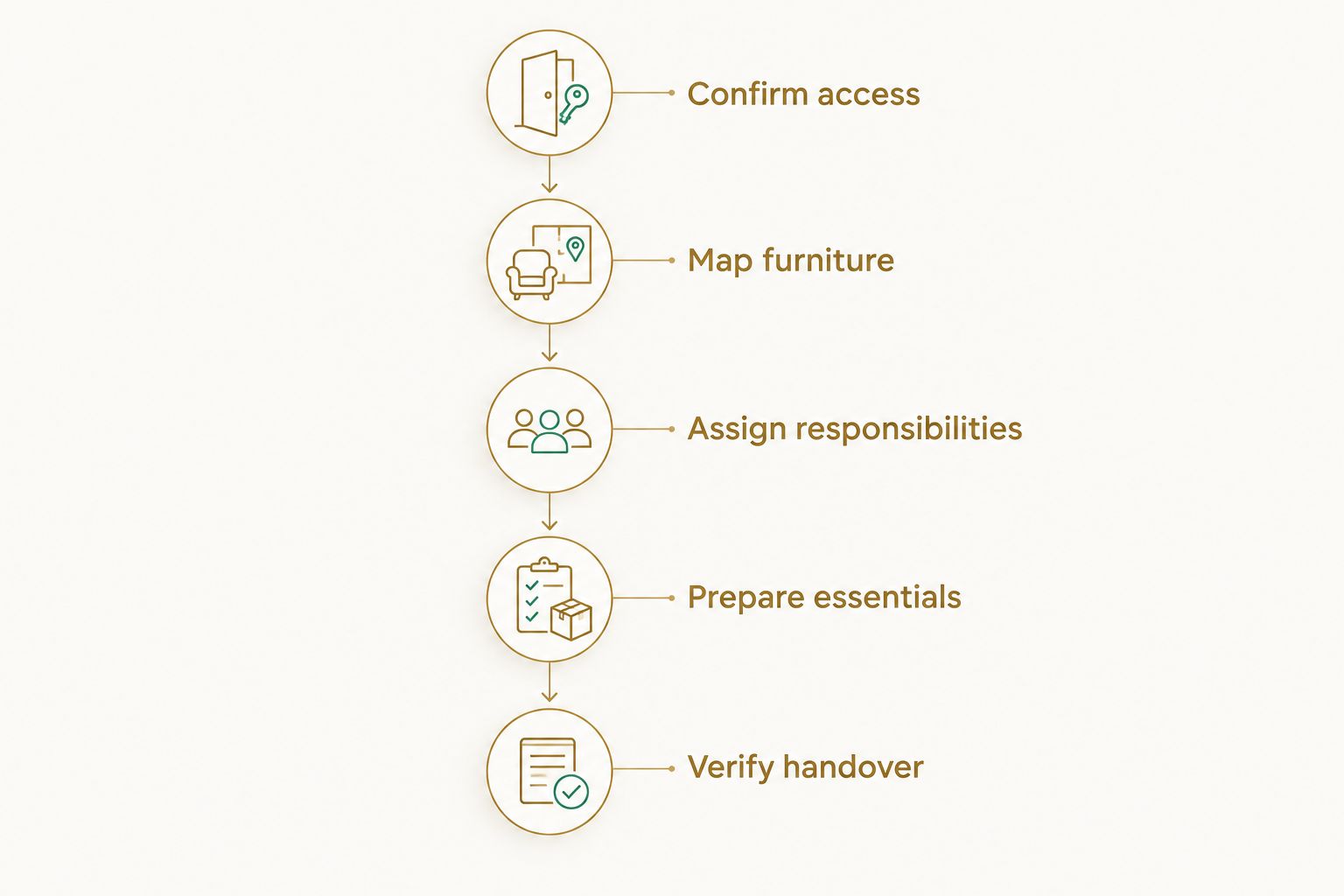
Use the planning sequence below as a handover reminder. Protection and arrival coordination remain separate checks within the full plan; the diagram highlights the main decisions from access through completion.
The final check should also distinguish delivery completion from resident support. Family or community staff should handle care-related questions through their established arrangements, not leave them with the moving crew.
- Compare completed work against the agreed task list.
- Locate essentials and confirm the intended furniture positions.
- Document concerns using the provider’s reporting process.
- Assign a named owner to each outstanding task.
Compare moving options for your community
Compare options against the same written scope in 2026. A transportation-only proposal and a coordinated setup proposal describe different amounts of work, even when both use the word moving.
The right option is the one whose responsibilities match your needs. More coordination is useful only when the agreement identifies who performs it and what completion means.
| Option | Best for | Main advantage | Key limitation |
|---|---|---|---|
| Family-led coordination | Families able to manage sorting, scheduling, and setup | Direct control over personal decisions | Family members retain responsibility for gaps and handoffs |
| Transportation-focused mover | Residents whose packing and setup are already arranged | A defined loading, transport, and delivery assignment | Unpacking, assembly, and installation need separate confirmation |
| White-glove moving provider | Homeowners prioritizing careful handling and agreed placement | Handling and placement can be specified together | The label alone does not establish packing, coverage, or setup terms |
| Moving provider plus installation specialists | Homes needing approved mounting, fixture, or assembly work | Separates transportation from specialist tasks | Requires coordination between providers and community staff |
For a family-led move, the benefit is control; the trade-off is the amount of organizing you retain. For a coordinated move, the benefit is fewer unassigned tasks; the trade-off is the need to define each service boundary carefully.
Common mistakes families and communities make
Treating move-in approval as installation approval
Permission to deliver furniture does not establish permission to drill into walls or change fixtures. Ask separately about TV mounting, chandelier installation, and any work affecting the building.
Correct it: obtain approval for the specific task before scheduling a specialist. Confirm who restores any altered surfaces if that responsibility applies to your agreement.
Moving every item before deciding what fits
A destination apartment should not become the sorting area for an entire former home. Bringing undecided furniture creates another handling decision after delivery.
Correct it: approve the floor plan first. Keep unresolved pieces out of the moving inventory until the resident has chosen their destination.
Assuming community staff will finish unpacking
A welcoming staff member is not a substitute for an agreed unpacking assignment. Family, provider, and community responsibilities need to be explicit.
Correct it: name the person responsible for bedding, clothing, kitchen essentials, and empty boxes. Ask community staff what assistance, if any, is actually arranged.
Letting relatives override the resident’s preferences
Efficiency is not permission to dispose of possessions or choose every furniture position. A technically completed move can still leave the resident unable to find familiar belongings.
Correct it: ask the resident which items and routines matter most. Keep those decisions visible in the packing labels and destination plan.
FAQ
What do moving services for senior living communities include?
Moving services for senior living communities include only the tasks stated in the provider’s agreement. Confirm packing, transportation, placement, unpacking, assembly, and removal of packing materials individually rather than assuming they come together.
What is the best moving option for a parent entering senior living?
The best option matches the parent’s preferences, the community’s access rules, and the work the family can realistically manage. Choose transportation-focused service when setup is already covered, or request a broader written scope when it is not.
Does white-glove moving include unpacking and furniture assembly?
White-glove moving does not establish a universal scope for unpacking or furniture assembly. Ask the provider to list included tasks, exclusions, and the condition in which each room will be left.
Can a moving company install a TV or chandelier in senior living?
Installation requires both an appropriate provider and permission for the specific work at the destination. Confirm community rules, who performs the installation, and any contractor documentation before booking it.
How do I compare quotes for a senior living move?
Compare quotes using the same inventory, access information, and task list. Check handling arrangements, packing responsibilities, assembly, coverage terms, and how changes are approved.
Who should handle medications during a senior living move?
The resident or an appropriate designated person should retain responsibility for medications during the move. Keep medication handling and care decisions separate from the moving crew’s transportation assignment.
What should be ready before the resident settles into the apartment?
Prepare the agreed sleeping area, accessible essentials, and clear routes through the apartment. Confirm that personal belongings are easy to find and assign any unfinished setup work to a named person.
One last thing
Use the resident’s first evening as your final planning test. Can the resident find familiar clothing, reach everyday belongings, and use the rooms arranged for them? Ask these questions while writing the scope, not after the crew leaves.
For your 2026 move, define completion as agreed household readiness rather than the last box crossing the threshold. That single change turns an unclear expectation into a task list your family, community contact, and moving provider can check together.