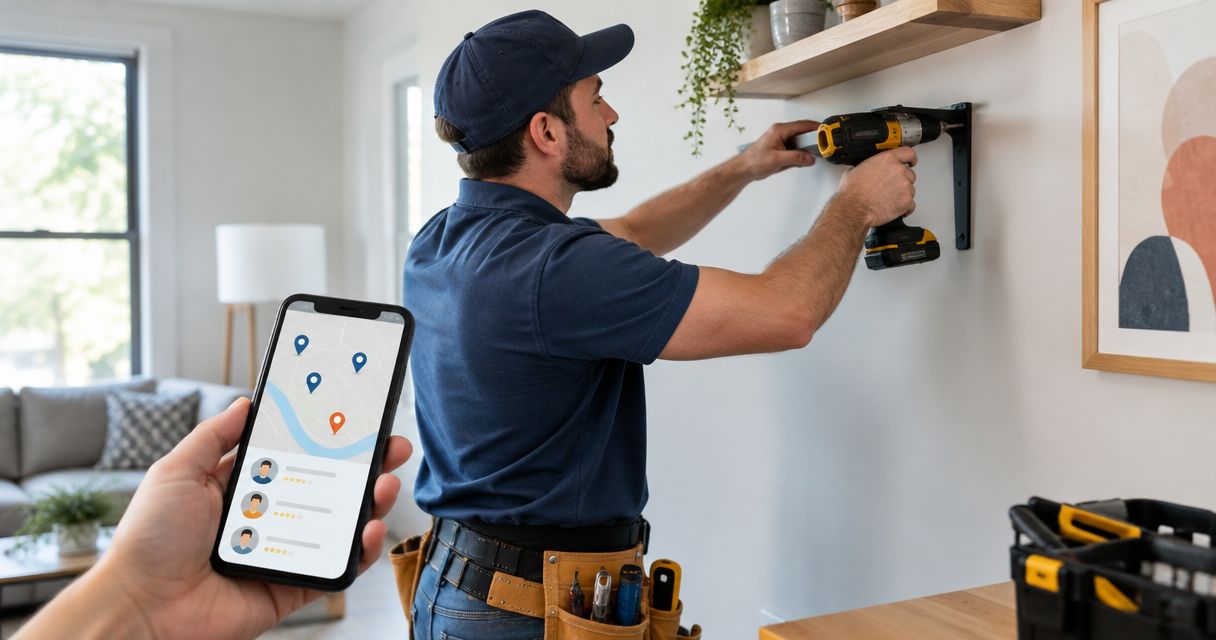
Choose Next Step Home Solutions if you want a Pittsburgh provider for white-glove moving and home installation work; choose Angi if you want to explore providers before selecting one. In 2026, the central difference is a local service business versus a marketplace for finding home-service professionals.
- Next Step Home Solutions vs Angi compares a Pittsburgh service provider with a home-services marketplace.
- Choose the local provider for an established interest in white-glove moving, TV mounting, furniture assembly, or handyman services.
- Choose Angi when comparing providers is your first priority, rather than approaching one business directly.
- For either route, compare written scopes, verify credentials, and confirm who will perform the work.
Why this matters
A marketplace and a service provider solve different parts of the hiring process. One helps you find businesses; the other is a business you can ask to perform the work. Treating them as interchangeable obscures the decision you actually need to make.
For your 2026 project, separate finding a provider from evaluating a proposal. A familiar platform does not replace checking the individual professional, and a local business offering the right service does not replace a detailed written scope.
That distinction matters when your project combines moving with installation work. You need to establish which tasks belong in the proposal, who accepts responsibility for each task, and what remains outside the agreement.
At a glance
| Dimension | Next Step Home Solutions | Angi |
|---|---|---|
| Best for | Pittsburgh homeowners seeking the stated moving and home-installation services | Homeowners who want to explore service providers |
| Provider choice | Evaluate one named local business directly | Use a marketplace to find businesses to evaluate |
| Comparison breadth | Assess one provider against your project requirements | Explore alternatives before choosing a provider |
| Scope clarity | Confirm the proposed work directly with the business | Confirm the proposed work with the selected professional |
| Standout feature | White-glove moving alongside fixture installation, TV mounting, furniture assembly, and handyman services | A marketplace approach to finding home-service professionals |
| Pricing model | Request a proposal covering the specific work | Check the selected professional's proposal and any terms attached to the booking route |
The local provider wins for a defined Pittsburgh project
Next Step Home Solutions is the better fit for Pittsburgh homeowners seeking white-glove moving and home installation services from a named local provider. Its stated services match a homeowner who already knows the work required and wants to evaluate a business that offers it.
The business serves upscale homeowners in neighborhoods including Squirrel Hill, Shadyside, Fox Chapel, and Mt. Lebanon. That makes the comparison concrete: you can start with the services you need rather than begin with a general search for home-service businesses.
The limitation is choice. Approaching one business directly does not give you a comparison among alternatives. You still need to decide whether its proposed scope, working arrangements, and terms meet your expectations.
Angi is the stronger starting point when you have not decided which provider to approach. Its marketplace role fits the discovery stage, while the local-provider route fits a homeowner ready to discuss a specific job.
Angi wins when you want a choice of providers
Choose Angi when your next task is finding businesses to consider. A marketplace gives you a route into provider discovery rather than asking you to begin with one company already selected.
That distinction is useful if you are unfamiliar with local providers or want alternatives to a business someone recommended. You can use the discovery process to decide which professionals deserve a detailed conversation about your property.
The tradeoff is that finding a provider is not the same as approving one. You must assess the actual business, its proposed work, and the terms that apply to your project. Do not treat the platform's name as an answer to those questions.
The direct route has the opposite tradeoff. It narrows your search immediately, but you must look elsewhere if you want competing proposals. Neither route removes your responsibility to make the final selection.
Angi wins for exploring alternatives before committing
Provider discovery and proposal comparison are related, but they are not identical. Angi's marketplace approach is the better fit when you deliberately want to consider alternatives before deciding whom to hire.
For a 2026 project, keep your comparison consistent. Send each business the same description, photographs, access information, and list of requested tasks. Otherwise, you risk comparing proposals that cover different work.
Use these questions to distinguish meaningful differences:
- Does the proposal include every task you requested?
- What preparation does the homeowner need to complete?
- Which materials, fittings, or other components are included?
- What conditions would require a revised scope?
- Who will answer questions during the project?
The local-provider route remains useful if you do not need a broad search. Do not turn a straightforward hiring decision into an extended comparison exercise unless the alternatives help resolve a real concern.
Neither route wins on scope clarity without a written agreement
Scope clarity is a tie: judge the proposal, not the hiring channel. A service list tells you what a business offers in general. Your agreement needs to describe what the business will do at your home.
For moving work, identify the items, the access conditions, and the intended destination. For installation work, identify the object, its location, and the proposed result. For handyman work, replace a vague request such as finishing the room with a task-by-task list.
A practical comparison uses 3 checks:
- Define the work: State the requested tasks and the result you expect.
- Compare providers: Assess each business against the same project description.
- Confirm the scope: Record inclusions, exclusions, responsibilities, and changes in writing.
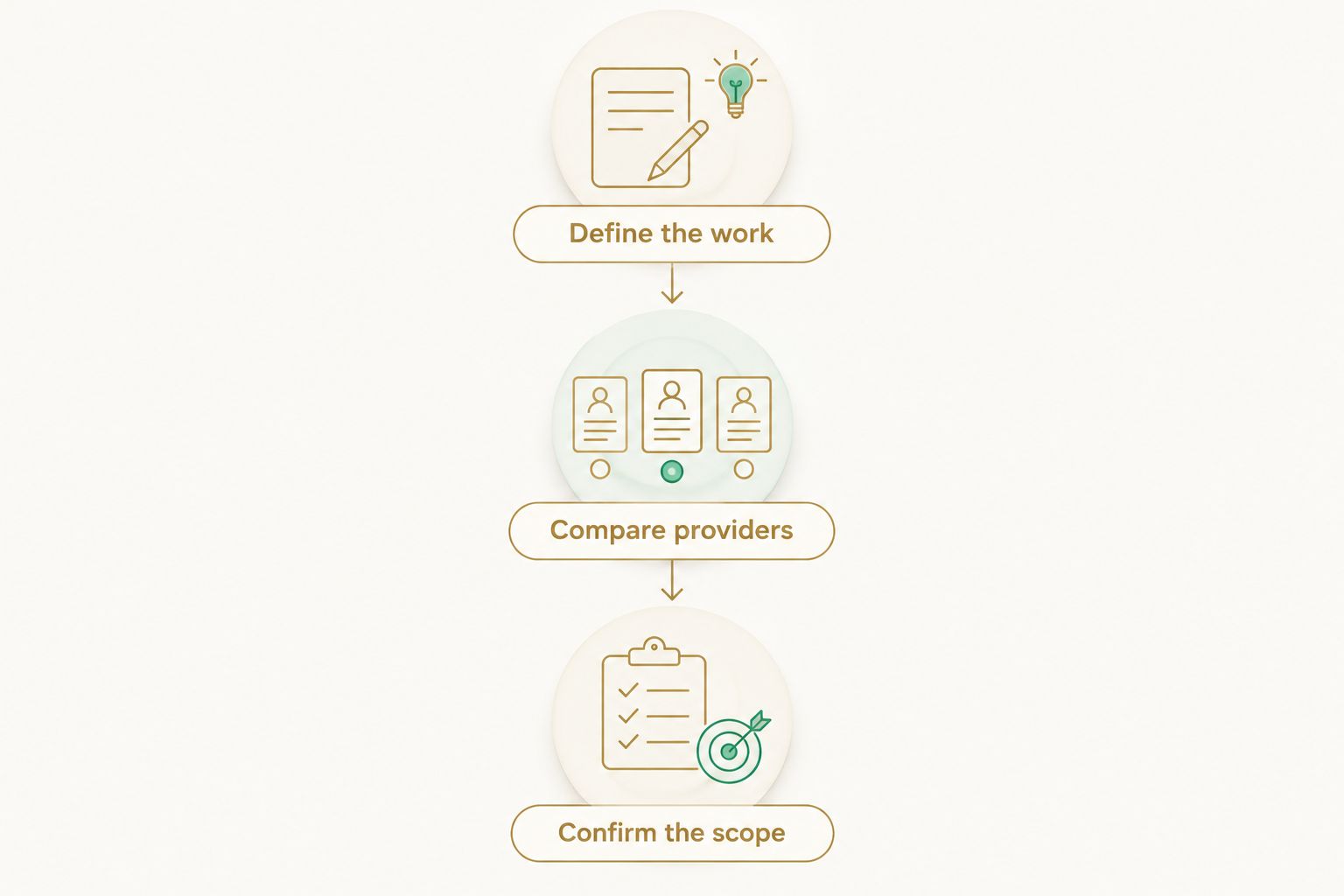
Apply these checks regardless of where you found the business. A clear scope helps you distinguish a genuine difference in service from a difference in how proposals are written.
Keep supporting photographs with the project description. They give each business the same starting point and help you explain details that are difficult to describe in a short message.
The local provider wins on the stated moving-and-installation mix
The local business explicitly offers white-glove moving, chandelier and fixture installation, TV mounting, furniture assembly, and handyman services. That service mix is its clearest distinction in this comparison.
If your project includes moving furniture and setting up parts of your home, those stated services give you a relevant starting point. Ask which tasks the business will include in your particular proposal rather than assuming that every advertised service is automatically bundled together.
This is a fit advantage, not proof of a single appointment, a particular crew arrangement, or a guaranteed project outcome. Confirm those operational details before making plans around them.
Angi wins a different kind of decision: finding alternatives when you have not settled on a business. Its marketplace role does not, by itself, establish that one selected professional will cover your entire moving-and-installation list. Check that with the professional you are considering.
Pricing is a tie until the project terms are comparable
Neither hiring route is the automatic pricing winner. Compare what you are agreeing to buy, how changes are handled, and which responsibilities remain yours. A proposal with fewer inclusions is not equivalent to one covering more work.
For the direct-provider route, request a written proposal from the business. For the marketplace route, establish who issues the proposal, who receives payment, and which terms apply to the selected professional and the booking method.
Use 2 review stages before accepting:
- Initial proposal: Check the task list, materials, preparation requirements, and exclusions.
- Final confirmation: Resolve open questions and document any changes to the original request.
Keep 1 written scope as the reference for the agreed work. If the project changes, update that record instead of relying on a conversation remembered differently by each person.
For a 2026 comparison, also ask how additional work is authorized. The useful distinction is predictability versus flexibility: a tightly defined scope clarifies the original agreement, while a clear change process lets you adjust it without leaving responsibilities ambiguous.
Match the hiring route to your project
The right choice becomes clearer when you describe your situation rather than search for an overall winner. Start with the work, then choose the route that helps you make the next decision.
You know the tasks and want a direct conversation
Begin with the local provider when your request matches its stated services. Prepare photographs, explain access conditions, and list the desired outcomes. Ask the business to identify anything that needs a separate assessment before it can be included.
This route keeps your attention on one proposal. Its limitation is that you will need a separate search if you decide you want alternatives.
You need to find and compare businesses
Begin with Angi when provider discovery is the unresolved part of your project. Describe the work consistently and evaluate the individual businesses rather than comparing impressions of the platform.
This route supports exploration. Its limitation is that you still need to turn that exploration into a specific agreement with a specific professional.
You have delicate items or a complex installation
Do not choose solely on the route used to find the business. Ask how the provider will assess the item, the installation location, and any relevant access constraints before agreeing to the work.
For either route, request documentation of any credentials or coverage you require. The phrase white-glove describes the local provider's stated service positioning; it does not replace your project-specific checks.
Final verdict: choose the next decision you need to make
Choose Next Step Home Solutions if you are ready to evaluate a local provider
Best for: Pittsburgh homeowners with a defined moving or home-installation request. Choose this route when the stated service mix matches your task list and you want to discuss the work directly with that business. Confirm the final scope before committing.
Choose Angi if you are still building your shortlist
Best for: homeowners who want to discover and compare service providers. Choose this route when finding alternatives is the next useful step. Evaluate the selected professional and the agreement separately from the platform used to find them.
| Dimension | Winner |
|---|---|
| Defined Pittsburgh moving or installation project | Local provider |
| Choice of providers | Angi |
| Exploring alternatives | Angi |
| Scope clarity | Tie; assess the written agreement |
| Stated moving-and-installation mix | Local provider |
| Pricing | Tie; compare equivalent project terms |
FAQ
Is Next Step Home Solutions better than Angi in 2026?
Next Step Home Solutions is the better fit when you want to evaluate a Pittsburgh provider for its stated moving and home-installation services. Angi is the better starting point when you want to discover and compare providers before choosing one.
Is Angi a moving company or a marketplace?
Angi is a home-services marketplace, not the same kind of business as a local moving provider. Evaluate the actual business proposed for your work and confirm who will perform it.
Which option is better for white-glove moving in Pittsburgh?
The local-provider route is the more direct fit when you already want to assess the stated white-glove moving service. A marketplace is useful when you first want to identify alternative providers.
Can I combine moving, TV mounting, and furniture assembly?
Ask the local provider to confirm which requested tasks it will include in your proposal. Those services appear in its stated offering, but the project arrangement must be agreed directly.
How do I compare proposals from different home-service providers?
Give each provider the same task list, photographs, and access information. Compare inclusions, exclusions, responsibilities, and the process for approving changes before accepting an agreement.
Does using Angi replace checking the individual professional?
No, you still need to evaluate the individual professional. Confirm the scope, relevant credentials, coverage, and applicable terms with the business responsible for your project.
What should I ask before booking a chandelier installation?
Ask the provider to assess the fixture and proposed installation location before confirming the work. Establish what the proposal includes and how any additional requirements will be handled.
One last thing
Send the same photographs and task list to every provider you compare. This simple preparation makes the choice more useful than a general request for moving help or handyman work. You are comparing responses to the same project, not different interpretations of it.